Decisions are made before release, but reactions only show up after.
Money for production, rights and marketing is committed before release, yet at that point there is no real audience-reaction data.

01. CINEMIND · SWARM-INTELLIGENCE PREDICTION ENGINE
CinemindALPHA
Cinemind is a content decision engine that simulates market reaction to your work in advance, inside an ecosystem where thousands to hundreds of thousands of virtual consumers live. Upload a script, synopsis, trailer or webtoon manuscript, change the ending, trailer or release cadence, and compare which choices create interest and buzz before release.

THE PROBLEM
Money for production, rights and marketing is committed before release, yet at that point there is no real audience-reaction data.
Collecting samples costs money, and every change to the plan means re-running the research. They simply add up individual answers and can't capture how audiences influence one another.
They can only explain results that already exist, and for new genres, formats or overseas markets there is little to compare against to begin with.
Differences in reaction by country and taste, and the buzz and controversy that spread through fandoms, reviews and social media, only become visible after release.
WHY CINEMIND
A group of hundreds of virtual consumers from different countries, cultures and tastes recommend, share and argue with one another. We plan to scale up to thousands to hundreds of thousands. Alternatives are compared by interest, immersion, drop-off and spread metrics.
Characters, events, conflicts and emotional shifts in the work become a content network, while audience groups, fandoms, critics, influencers, media and platforms become a market network — and the two are linked. You can trace which scene drives which audience's behavior.
Even the same viewer judges differently depending on whether they saw the trailer, got a friend's recommendation or ran into a controversy. Each virtual consumer has a disposition, prior experience, current state and memory, and chooses on its own to watch, hold off, drop off, pay, recommend or criticize.
Runs across multiple rounds — pre-release, early release, spread and sustain — applying different exposure and behavior rules for social media, fan communities, review spaces and content platforms.
Get the moment reaction turned, the audience groups that drove spread, and the scenes and lines behind it in a report. If you're curious, ask the virtual consumers directly.
After release, we compare actual audience, viewing and payment data with predictions and correct the model by the gap. The more experiments accumulate, the more calibration baselines grow.

HOW IT WORKS
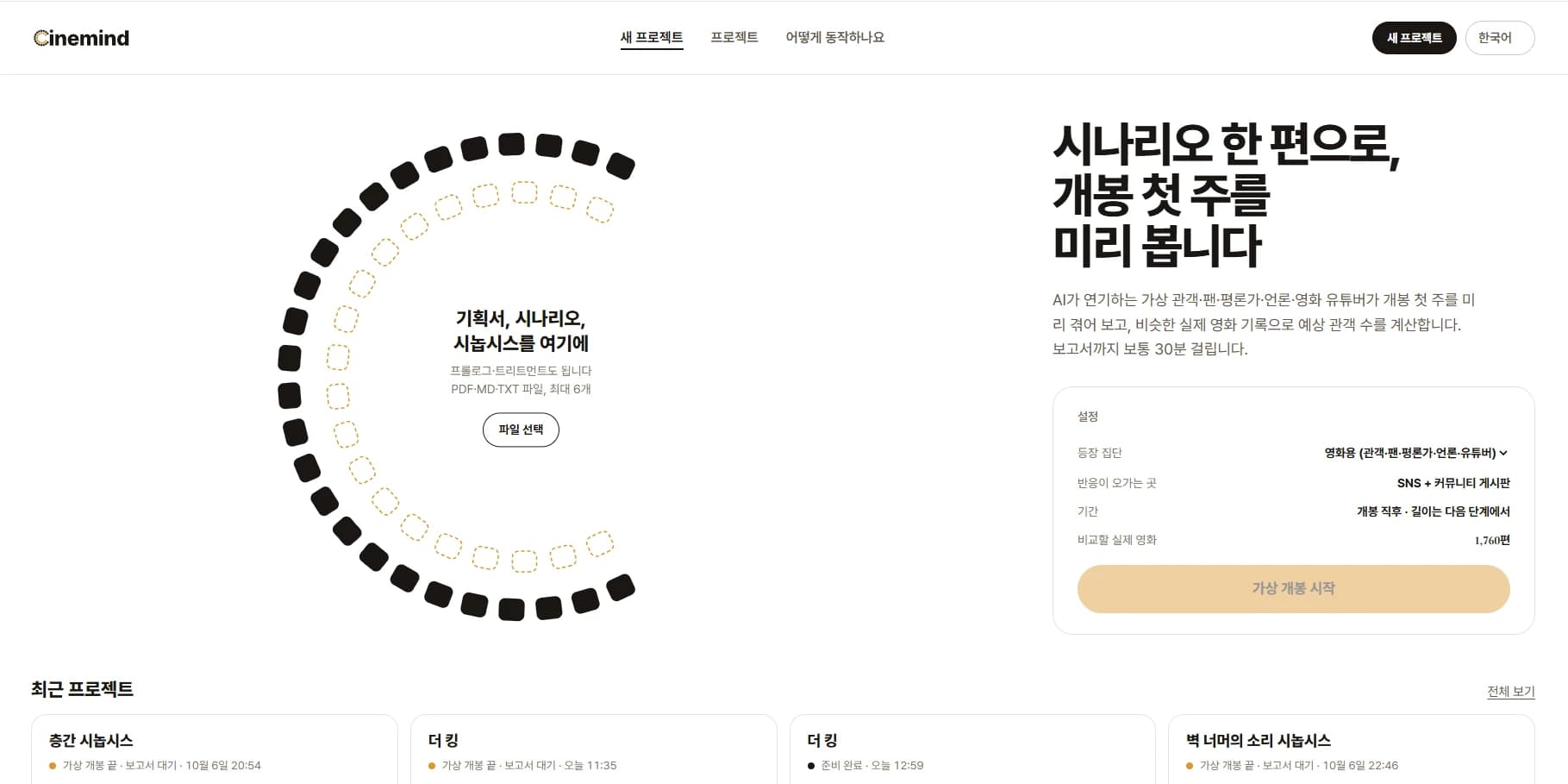
From inputting materials to a comparison report, an experiment is done in five steps.
Upload scripts, synopses, trailers or webtoon manuscripts and choose target countries and audience groups
Review and edit the extracted characters, events, emotions and episodes
Define the baseline and variant, and specify variables such as ending, trailer and release cadence
Set the number of agents and rounds, run it and watch progress
Compare results and follow the evidence through virtual-consumer interviews
KEY FEATURES
From scripts, video and webtoons we extract characters (relationships, motives, personality changes), events (causality, order, twist positions), conflicts (axes of opposition, escalation, resolution), emotional shifts (scene- and episode-level emotion curves), and scenes and episodes (length, placement, cliffhangers). Episode-level tension and likability curves and character relationship maps show drop-off risk zones and twist points at a glance.
A table shows how well narrative elements such as a fast opening, share of romance, twist ending, fidelity to the original and cliffhangers fit audience groups like original fans, new viewers in their 20s, overseas romance fans and thriller lovers. Elements where fit diverges can go straight into a condition-change experiment.
Along with per-episode interest curves by condition, we summarize five things for you.
Ask virtual consumers directly, such as “Why did you hold off watching at episode 2?” Answers can be checked against the exposure and behavior history actually recorded for that agent, and are labeled separately from real consumer interviews.
Each run automatically accumulates agent states, exposure and behavior history and records the experiment version and seed. With the same conditions, you can run the same experiment again.
USE CASE
Example: should we add a twist ending? — A single twist revealed in episode 8 sends each audience group down a completely different path.
Original fans
New viewers
Run Ending A (twist) and Ending B (original) repeatedly with the same audience mix and initial conditions, and you can see where paths diverge by audience group after the episode 8 reveal — and why. (Example)
BUILT FOR
Teams facing hard-to-reverse decisions such as production approval, rights purchase, casting and marketing budgets. Compare reactions to each alternative before release and decide on solid evidence.
Teams that must set episode structure and release cadence. Short dramas in particular have short release cycles, so predict → verify → calibrate runs quickly.
Teams who want to see in advance how original fans and new audiences will react differently when adapting a work to video or taking it overseas.
Teams that want to attach reaction prediction to whole IP portfolios and campaign decisions. An annual-contract API and a dedicated analysis environment can connect to your own content, viewing and purchase data.
TRUST & SAFETY
Predictions are submitted before release to lock the timestamp and are never edited afterward. Hits and misses are reported together.
Differences in a report are effects inside the model. We advise verifying actual causal effects with separate experiments such as A/B tests.
We compare against real interest, viewing and purchase metrics on a held-out validation set that contains only pre-release information, and evaluate how much better we do than simple baselines such as similar titles or genre averages.
Uploaded manuscripts are stored isolated per customer, and separate consent is required before they are used for training.
Audience and market data are used only in aggregate, with personally identifiable information removed.
Content manuscripts, audience and market data, real results and simulation logs are stored separately, and training and validation data are kept apart.
ENGAGEMENT
We are currently running a pilot on the IP of Korean film production companies.
Pick one or two real choices on a work with a set release date and work with you from prediction through post-release verification.
Choose one or two among ending, trailer, release cadence and target country
Submit predictions before release to lock the timestamp. No edits afterward
The customer actually releases the work and runs the campaign
Compare audience, viewing and purchase metrics with the predictions
Analyze causes of error and adjust parameters
Summarize as a reference within the scope the customer consents to
COMING SOON
We will let you know the release schedule once it is confirmed.
This product is currently in developer testing (ALPHA). Features and schedules may change.
GET STARTED
Preview the market reaction you used to check only after release, right at the planning stage. From concept to global hit, prepare with Cinemind.